Rim Joist & Band Joist Insulation
A dedicated rim joist and band joist scope, run by a certified crew with its own setup, its own coverage check, and its own warranty paperwork instead of ten leftover minutes at the end of a bigger job.
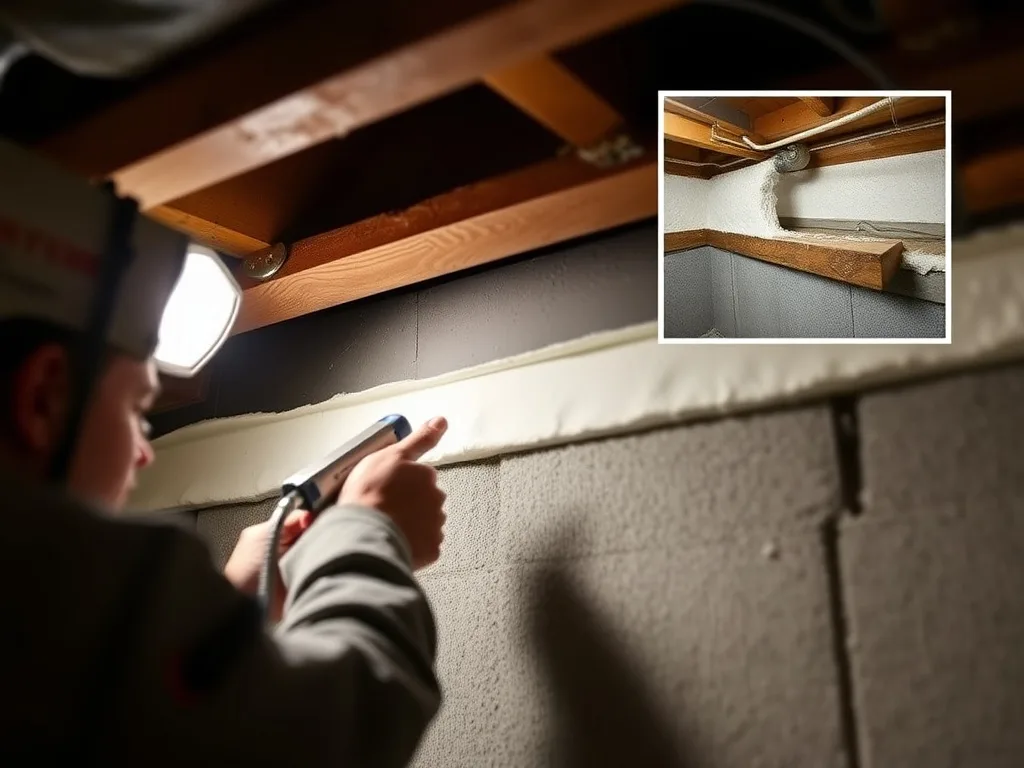
The rim joist — sometimes called the band joist — is the strip of framing that runs around the perimeter of a house where the floor system meets the foundation. It is one of the largest sources of air leakage and cold in most homes, and it is also one of the smallest jobs on a spray foam crew's schedule. That combination is exactly why it gets treated badly. On a lot of jobs, rim joist work is whatever is left in the rig's tank after the main scope is done, sprayed fast, by whoever is closest to the hose.
It's easy to see why. A rim joist run rarely takes more than an hour or two, the material cost is small compared to an attic or whole-wall job, and the work happens in a basement or crawl space that almost nobody walks through and inspects afterward. Every incentive on a job site points toward treating it as filler work instead of a scope in its own right — which is exactly the gap a certified crew is trained to close.
Foam Masters runs rim joist and band joist insulation as its own scope, not a leftover. That means a certified installer scopes the perimeter before spraying, checks for wiring, plumbing, and dryer vents that need protecting or boxing out, and treats every joist bay as a piece of work that gets inspected, not just covered.
Foam Masters is the standard-of-craft spray foam network — every crew is certified, every job is warranty-backed, and every install is quality-checked, not just quoted. On a job this small, that standard is easy to skip and easy to prove when it's followed.
Why this holds up over time
- Certified installer scopes the full perimeter before spraying — not a rushed pass with leftover material
- Every joist bay treated as its own unit, with gaps and rim board seams checked individually
- Wiring, plumbing penetrations, and dryer/bath vents identified and protected before foam goes on, preventing hidden damage
- Consistent coverage on a notoriously irregular surface — sill plates, header joists, and cross bracing all get checked, not just the easy flat runs
- Same documented workmanship warranty as a full attic or wall job — this scope doesn't get a lesser standard because it's smaller
- Air-seal and thermal boundary addressed together, closing the gap where floor framing meets foundation
Why This Scope Gets Rushed — And Why That's a Problem
Rim joist insulation looks simple from the outside: a narrow band, a short run, done in minutes. That perception is exactly what makes it a target for shortcuts. On jobs where a general contractor or a non-specialist crew handles it, the rim joist is often the very last thing sprayed, using whatever foam is left in the equipment, by whoever happens to be holding the gun. There's rarely a dedicated setup, rarely a second look, and rarely any documentation that the job was done at all.
The problem is that the rim joist isn't actually simple. It's an irregular assembly — sill plate, joist ends, header, subfloor overhang, cross-bracing, and often wiring or plumbing running straight through it — packed into a tight, hard-to-see band around the entire foundation perimeter. A rushed pass leaves gaps at joist ends, thin spots where the gun angle was wrong, and missed bays behind obstructions. Nobody catches it later, because nobody goes back and looks at rim joist framing once the basement ceiling or crawl space is closed up.
There's also a cost side to the shortcut. Leftover material from the tail end of a larger job is frequently a different mix ratio than what a rim joist scope actually calls for, or it's simply not enough material to properly fill every bay, so the crew stretches it thin across the perimeter rather than mixing a fresh, correctly proportioned batch. A homeowner who paid for rim joist insulation as a line item on their invoice has no easy way to verify that what actually happened matches what they were charged for — which is precisely why documentation and a dedicated pass matter here more than almost anywhere else in the building envelope.
- Rushed or leftover-material jobs skip joist bays that are hard to reach or partially obstructed
- No dedicated scoping means wiring or vent penetrations get discovered mid-spray instead of planned around
- Uneven pass thickness on a non-flat surface leaves cold spots that don't show up until the next heating season
- Because the area is buried behind finishes soon after, a bad job has no natural check-back point
Treating the Rim Joist as Its Own Job
A certified Foam Masters crew doesn't fold this scope into the tail end of a bigger job and call it done. Rim joist and band joist work gets its own walkthrough first: the installer traces the full perimeter, identifies every joist bay, flags wiring, plumbing stacks, and vent penetrations that need protection, and confirms whether any bays are already insulated with old fiberglass that needs to be pulled before spraying.
That prep step matters because the rim joist sits at a structural and mechanical crossroads — it's where electrical runs pass through framing, where dryer and bathroom exhaust vents often exit the house, and where sill plates meet foundation. Spraying without accounting for all of that risks trapping a vent line in foam or missing a bay because a wire bundle was in the way. Scoping first is what separates a planned install from an improvised one.
The walkthrough also sets up equipment correctly for the space. Rim joist bays are often tight, low-clearance areas where a crew is working at an awkward angle for an extended stretch, and mix-ratio equipment needs to be dialed in and confirmed before the first bay is sprayed rather than adjusted on the fly mid-run. A certified installer treats that setup step as non-negotiable, the same way it would be treated on a full attic or wall scope, because a rim joist bay sprayed with an off-ratio mix is just as prone to brittleness or poor adhesion as any larger surface would be.
Bay-by-Bay Coverage Verification
Once spraying starts, the crew works the perimeter bay by bay rather than treating it as one continuous pass. Each joist bay gets checked individually for full coverage — sill plate, joist ends, and the header above the foundation wall all need foam reaching into the corners, not just a surface skim across the visible face.
This bay-by-bay approach is what catches the gaps that a rushed job misses: a joist bay that's harder to reach because of ductwork nearby, a corner where the gun angle didn't fully fill the cavity, or a section behind a support post that got skipped entirely on a first pass. Foam Masters crews check as they go, not after the fact, so a thin spot gets a second pass immediately instead of being discovered by the homeowner as a cold spot two winters later.
Corners and transitions get particular attention. Where the rim joist perimeter turns a corner, or where it meets a beam pocket, chimney chase, or an old foundation vent that's since been sealed, the geometry gets more complicated and a rushed pass is most likely to leave a gap. A certified installer slows down at exactly these points instead of speeding through them, because these transition areas are consistently where an uncertified crew's work falls apart first.
The Post-Install QC Check
Every rim joist scope ends with the same post-install check applied on Foam Masters' larger jobs: a visual and thickness verification pass across the completed perimeter before the crew calls it finished. The installer confirms full-bay coverage, checks that no penetrations were compromised, and documents the completed scope as its own line item — not folded silently into a larger job invoice with no record of what was actually done.
That documentation is the difference a homeowner can point to later. If a question ever comes up about whether the rim joist was actually treated, or how, there's a record — not just a memory of a contractor who was in the basement for twenty minutes.
The check also confirms that nothing was compromised along the way — that a dryer vent still exhausts cleanly, that no wiring was nicked or oversprayed in a way that would complicate a future electrical inspection, and that any plumbing penetrations sealed with foam are actually sealed rather than just partially covered. A job this size still has real mechanical and structural stakes attached to it, and the post-install check treats it that way instead of assuming a quick visual glance is good enough.
Open-Cell or Closed-Cell for This Application
Either foam type can be used on rim joist and band joist framing, and the right call depends on the specific conditions of the space. Closed-cell (R-6 to R-7 per inch) adds rigidity and a moisture-resistant skin, which is often preferred in damp basements or where the rim joist sits close to grade. Open-cell (R-3.5 to R-3.7 per inch) fills irregular cavities well and costs less per square foot, and it's a solid choice in drier, well-ventilated basements.
A certified installer makes this call based on moisture exposure, proximity to grade, and whether the space below is a conditioned living area or an unfinished mechanical space — not based on whichever foam happens to already be loaded in the rig that day.
This is also where an uncertified crew's shortcuts show up fastest. Closed-cell foam applied too thick in a single pass in a tight rim joist bay can generate more heat than a thin, well-ventilated bay can dissipate, leading to scorching or poor cure. A certified installer knows to build closed-cell up in controlled lifts even in a scope this small, rather than treating a quick rim joist run as an exception to pass-thickness discipline that applies everywhere else in the house.
Ideal for
- Homes with cold floors, drafts near baseboards, or a chilly first-floor perimeter in winter
- Basements or crawl spaces being finished or converted to conditioned space
- Older homes with fiberglass batts stuffed into rim joist bays that have settled, sagged, or gone moldy
- New construction or renovation projects where the rim joist is exposed and accessible before finishes go in
- Homeowners who had a whole-house energy audit flag the rim joist as a top air-leakage point
- Anyone who had rim joist work done as an afterthought on a prior job and wants it re-verified or redone correctly
What affects the cost
Rim Joist & Band Joist questions, answered
It can be bundled efficiently when a certified crew scopes it properly, but the risk is when it gets treated as an unplanned add-on with no dedicated walkthrough. Foam Masters scopes the rim joist perimeter, wiring, and vent penetrations before spraying regardless of whether it's paired with a larger job or done standalone, so the scope gets the same attention either way.
Spray foam used in rim joist applications meets standard building and fire code requirements, and a certified installer accounts for clearance to mechanical equipment and combustion appliances as part of the scoping walkthrough, not as an afterthought during spraying.
It depends on access. If the rim joist band is exposed in an unfinished section of the basement or crawl space, it can typically be sprayed without any demolition. If it's fully enclosed behind a finished ceiling, some limited access work is usually needed — a certified installer will assess this during the initial walkthrough rather than guessing.
A properly done job leaves documented coverage and a workmanship warranty on file. If a past contractor didn't provide either, a Foam Masters crew can inspect the existing rim joist condition and identify gaps, thin spots, or missed bays before deciding whether re-work is needed.
Yes. Foam Masters applies the same certified-crew standard and documented workmanship warranty to rim joist and band joist scopes as to any other part of the building envelope — the scope doesn't get a lesser standard because the job is smaller.
Rim Joist & Band Joist is only as good as the crew and the checks behind it
Two crews can quote the same rim joist & band joist scope and hand you two very different results, because the material never tells on a rushed pass — a wall board or attic deck closes over the work either way. Foam Masters connects you with installers who are certified specifically on this service, trained to catch the technique mistakes that don't show up until years later.
We work with homeowners, builders and general contractors, and commercial property owners nationwide, and every job starts with a free, no-pressure assessment scoped to your specific space.
What you get isn't just a finished spray — it's a documented job. Certified crews record what they checked as they worked: lift thickness, mix ratio, full-cavity fill, whatever the service calls for. That record, plus a written workmanship warranty on the installation itself, is what backs up the rim joist & band joist you paid for, long after the crew has moved on to the next job.
Free, certified assessment
A certified installer evaluates your space and gives you a clear, itemized quote — no pressure, no guesswork.
Quality-checked application
Your rim joist & band joist is applied to spec, with lift, mix, and coverage checked on site as the job happens.
Documented, warranty-backed
A written workmanship warranty and a job-specific QC record you can keep, not just a verbal assurance.
Related services
Ready for a free rim joist & band joist quote?
Tell us about your project and we'll connect you with a certified crew for this exact service — a clear quote, a written scope, and a workmanship warranty in writing.